

Tote-ally Worth It: Farmer's Market Season


A 5,000 Year-Old Idea (that almost died in the 1950s)
Before there were grocery stores, food apps, or the concept of "mile radius," there were markets. The first recorded ones trace back to ancient Egypt, where vendors lined the banks of the Nile selling produce and goods to travelers passing through, over 5,000 years ago. In the American colonies, the tradition arrived with European settlers: Boston opened the country's first official farmers market in 1634 under Governor John Winthrop, followed by New York City in 1686 and Philadelphia in 1693. Lancaster, Pennsylvania set aside a dedicated public market square in 1730 that still operates today. For centuries, the farmers market was simply how people ate.
Then came refrigeration, highways, and the supermarket. By the mid-20th century, farmers markets had nearly disappeared in the US. Improved roads meant food could travel farther, wholesalers could offer better prices, and centralized grocery chains became the dominant model. Cities actually passed laws making curbside farm sales illegal in many places. The farmers market wasn't nostalgic yet, it was just inconvenient.
The comeback started in the 1970s, driven by a growing organic food movement and a consumer hunger (couldn't help myself) for something more direct. Today, there are over 8,000 farmers markets in the United States alone, and the movement has gone global. Lonely Planet's 2025 Best in Travel guide named Tasmania's Farm Gate Market in Hobart one of the world's ten best markets, alongside Nishiki-koji Ichiba in Kyoto, the Neighbourgoods Market in Cape Town, and Mercado San Pedro in Cusco. And earlier this year, Alexandria, Egypt inaugurated its first farmers market in central Saad Zaghloul Square: a full-circle moment for a tradition that started along the Nile.
The "Buy Local" Story Is Important, But For A Different Reason
Peak farmers market season is here, and with it comes the warm glow of feeling like you're doing the right thing for the planet (and you probably are! You're doing great). But the reason might surprise you.
The "food miles" argument, the idea that buying local dramatically cuts emissions because your tomato didn't fly in from Mexico, is real but wildly overstated. According to Our World in Data, transport accounts for just 5 to 6 percent of food's total greenhouse gas emissions. The vast majority of emissions, roughly 83 percent according to research from Carnegie Mellon, come from food production itself: how land is used, what animals are raised, and what farming methods are employed. Your last-mile truck delivery matters less than you'd think, but your last-mile steak matters enormously.
Let's talk about what this means in practice: a locally raised beef burger can easily out-emit a conventionally grown tomato shipped from halfway across the country. Buying a bag of California spinach at the grocery store in New York might actually have a lower footprint than the same spinach grown in a heated Brooklyn greenhouse. The Idaho potato traveling by rail from 2,000 miles away can have a smaller carbon footprint than the Maine potato trucked 300 miles, because trains are dramatically more efficient than trucks.
So the real sweet spot at a farmers market is the overlap: produce that's local, in season, and grown without heavy synthetic inputs. That's where the climate math and the flavor both work in your favor.
What To Buy
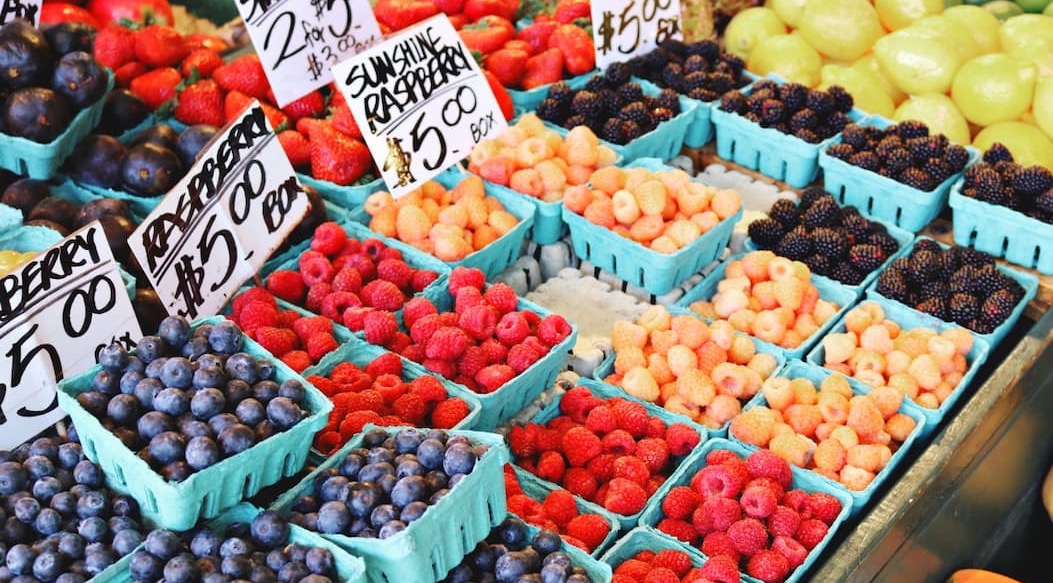
Berries and stone fruits. These are the farmers market's superpower. Perishable fruits like strawberries, raspberries, peaches, and cherries don't survive long-haul transport well, which is why the grocery store version is often picked underripe and treated with fungicides. At the market, they've usually been harvested within 24 to 48 hours. Better flavor, less intervention, and frequently fewer pesticides.
In-season vegetables. This is where the food miles nuance actually works in your favor: a field-grown summer squash or ear of corn that's in peak regional season has both a low production footprint and essentially zero cold chain required. Compare that to the same vegetable in January, when "local" might mean a heated greenhouse.
Eggs and dairy. When farms are small enough to sell directly at markets, the transparency about practices is usually higher than what you'll find at a grocery store. Ask about the hens' diet and outdoor access. Most vendors will tell you more than any label would.
Ugly produce. One of the most underrated things a farmers market offers is imperfect produce that'd never make it onto a grocery shelf. Buying it directly reduces food waste at the source. Win.
Where To Be Skeptical?
Not everything at a farmers market is what it appears. Some markets allow vendors to resell wholesale produce, which means that beautiful display of avocados might have come from the same distributor as your grocery store's. Ask vendors directly: "Did you grow this?" Most honest farmers are happy to answer, and most markets have rules about this, but it's worth knowing yours.
The word "organic" deserves the same kind of curiosity. It helps to know what certification actually involves. Before a farm can label anything organic, its land has to go three full years with no prohibited synthetic pesticides or fertilizers. Throughout that transition window the crops are already being grown to organic standards, but they still can't be sold or labeled organic. The farm absorbs three years of higher costs and lower yields with none of the price premium that makes organic pay off. For a small operation on thin margins, that gap is often the whole reason they never apply. They keep farming carefully and skip the paperwork. So a missing seal at a market usually just tells you certification was too slow and expensive to be worth it for a small grower. It says very little about what's actually in the soil.
There's a second wrinkle that trips people up. Farms selling less than $5,000 a year in organic products are exempt from certification entirely. They're allowed to use the word "organic" as long as they follow the standards, they just can't display the official USDA Organic seal. So at a small market you might see "organic" chalked on a sign from a farm that's genuinely organic and perfectly legal without certification, sitting right next to a stand with no label at all that's farming exactly the same way. The seal and the sign both tell you less than the grower will. Ask what they spray and how they handle pests. Someone using clean practices is usually glad to walk you through it.
If you'd rather have a shortcut for where organic matters most, The EWG's Dirty Dozen list is a useful guide for which fruits and vegetables are highest priority to buy organic (strawberries, spinach, peaches, and grapes tend to top the list every year). And the prepared food stalls, as delicious as they are, often come with a significant markup that's more about ambiance than ingredients. Budget accordingly.
Bring a tote, bring cash, and ask more questions than you think you need to. That's the whole game.
Subscribe now to continue reading.
(16% discount)
• Access to unlimited articles
• Sustainable product guides & recommendations
• Weekly newsletters
Already a member? Log in.
.jpg)