


The Original Environmentalists Were The Founding Fathers


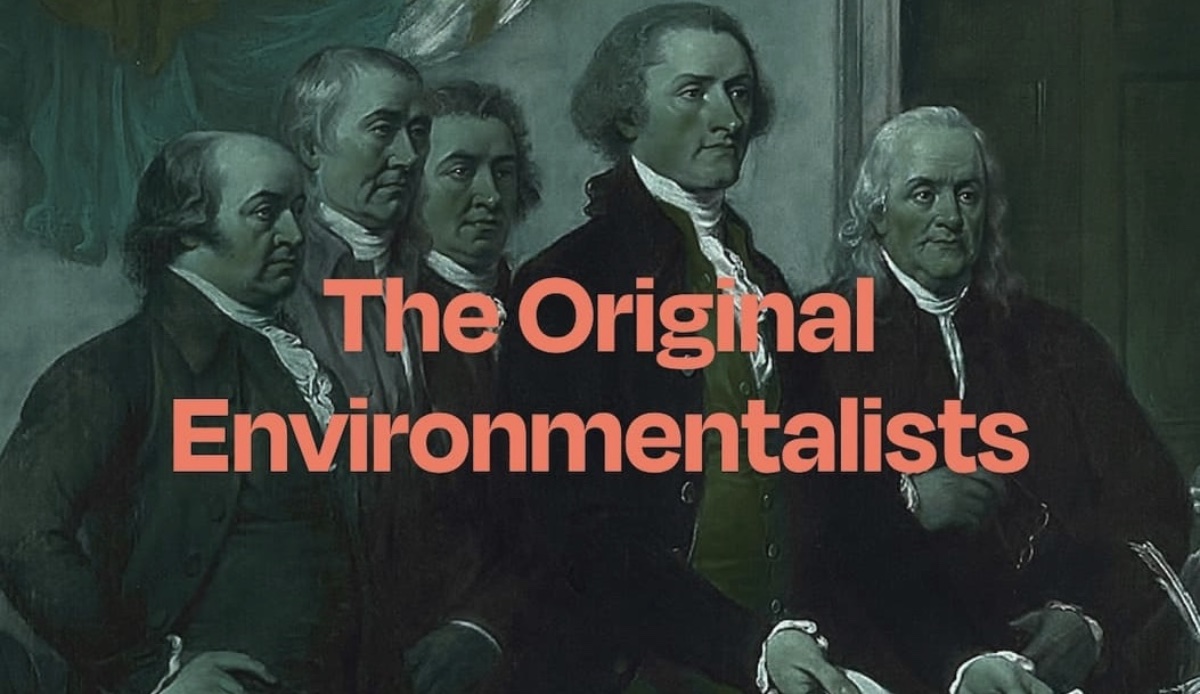
Something that tends to get lost in the tricorn mythology is the idea that the founding generation were environmentalists. They understood, with a kind of practical urgency that we’ve largely lost, that the land was everything. When it’s wasted, depleted and mismanaged, we lose the country. Full stop.
George Washington kept meticulous agricultural records at Mount Vernon – farming technique was, according to historian Garry Wills, his “principal intellectual discipline.” He experimented with cover crops to prevent soil erosion and rotation systems to keep his fields productive. Thomas Jefferson pioneered contour plowing at Monticello (he actually picked up the technique while watching French farmers during his time abroad) and grew over 300 varieties of fruits and vegetables as part of what was essentially a living sustainability experiment. And then there’s James Madison: most people know him as the father of The Constitution, fewer know that in 1818, a year after leaving office, he gave a speech warning that nature was a “fragile ecological system” and called on his fellow citizens to protect the environment decades before the conservation movement had a name. Historians have started calling him the forgotten father of American environmentalism, so I guess the fact that he was just five feet four inches tall and 100 lbs just became the second most surprising thing about him.
The Franklin Stove
Franklin deserves his own paragraph, because the story is richer and more complicated than the standard “inventor of a fuel-efficient fireplace” summary suggests. Harvard historian Joyce Chaplin just published a book entitled The Franklin Stove: An Unintended American Revolution that reframes the whole thing, and it’s worth knowing about.
Franklin actually invented five different versions of the stove over more than 40 years of his life, because he and his contemporaries were genuinely worried that two grim trends were converging on them: climate change (the Little Ice Age was producing devastating cold across the North Atlantic) and resource depletion from burning through American forests at an unsustainable rate. Sound familiar? The problems were the inverse of ours, but the logic – intersecting climate and resource crises demanding urgent technological response – is identical.
What’s striking is how far Franklin’s thinking actually went. Far beyond trying to simply heat a room, he was using his stove experiments to develop early theories of atmospheric science. He questioned whether deforestation of North America would produce catastrophic warming at a time when his contemporaries were insisting it was a good thing, he observed what we now call microclimates, and he tried to design heating that minimized air pollution. A friend teased him for being a “universal Smoke Doctor.” The man was 250 years ahead of schedule.
The stoves were cast at Pennsylvania ironworks that relied on enslaved labor. Franklin’s early work accepted the social inequities of his era rather than confronting them – something he only rectified later in life when he became an abolitionist. The book’s argument is that you can’t tell a clean “visionary founder” story without also reckoning with what got encoded into early American industrialization: the assumption that growth was infinite, that nature had no real limits, and that some people were resources rather than people. Those assumptions, not the stove itself, are what ultimately led us here.
Chaplin’s closing frame is worth sitting with as we head into a holiday weekend. With America’s 250th anniversary approaching in 2026, she notes that 2030 is when the IPCC says emissions must be halved to prevent the worst of climate change. Franklin, she writes, may have had a greater long-term impact through the industrial revolution his stove helped usher in than through any of his political contributions. We are, in her words, “Franklin’s posterity – participant-observers in a continuing experiment in energy efficiency and resource conservation.”
His almanac persona Poor Richard had a saying for moments like this: festina lente. Make haste slowly. Both urgency and care, at the same time. Not a bad framework for July 4th, 2026. These weren’t hippies with Birkenstocks, but pragmatists who understood that self-sufficiency depended on not destroying the systems that made it possible. The full story is complicated, but the ingenuity was there from day one.
So Where Did That Energy Go? Who Has It Now?
The U.S. didn’t necessarily abandon those founding instincts overnight, and there are, of course, incredible people and companies doing that work here every day. But, when we look at countries that are leading on sustainability today, the gap can be hard to ignore.
A few countries worth knowing about:
Denmark: 88.4% of electricity from renewables
Denmark started investing seriously in wind power after the 1973 oil crisis – a resource shock that maps onto the same self-sufficiency logic the founders were working from. The result? In 2024, 88.4% of Denmark’s net electricity came from renewables, the highest share in the EU. What makes this especially remarkable isn’t the technology. It’s the politics: Denmark has had consistent, cross-party support for climate action for a generation. There are small policy changes between governments, but no arguments or reversals about the basic direction. Their 2020 Climate Act legally obligates the government to cut emissions 70% by 2030. It passed with broad cross-party support. If festina lente were national policy, it would probably resemble this.
The Netherlands: A government-mandated goal of a fully circular economy by 2050
The Netherlands has made a circular economy – the idea that nothing is “waste,” only a resource waiting for its next use – a national policy priority. They’re actively legislating raw material reduction, encouraging sharing and reuse, and building public-private frameworks to keep materials in circulation. Franklin worried about running out of wood and tried to design around the constraint. The Dutch have made that same logic – don’t deplete what you can’t replace – the organizing principle of their entire economy. The US doesn’t have a national circular economy strategy. The Netherlands has a timeline.
Japan: A Culture with a word for the guilt of wasting resources
Japan’s approach is less policy, more philosophy. The concept of mottainai, a Buddhist-rooted word used to express regret or guilt when something is wasted, is baked into everyday life in a way that has no American equivalent. It shapes how people shop, repair, package, and dispose. When your language has a word for the feeling of wasting something, your relationship to consumption is structurally different. Franklin may have tried to engineer thrift but Japan culturally encoded it. So now I guess they can claim cultural superiority AND better powder to ski.
Strip away 250 years of mythology and the founders were people who understood that a country is finite. There's only so much soil, so much forest, so much clean water inside these borders. Washington knew it watching his fields erode and Franklin knew it worrying about running out of wood. The patriotism they were practicing came down to refusing to spend the place down to nothing. We've lost that proximity to the land, but the math hasn't changed. We can leave behind more forest or more landfill, and festina lente still applies: there's no version of this where we get the country back once we've wasted it.
Subscribe now to continue reading.
(16% discount)
• Access to unlimited articles
• Sustainable product guides & recommendations
• Weekly newsletters
Already a member? Log in.


