

The Wild Supply Chain Behind Your Pumpkin Spice Everything


The Wild Supply Chain Behind Your Pumpkin Spice Everything
Ahh, September. Halloween candy has already flooded the CVS aisles, the leaves are barely turning, and we’re inching closer to “sweataweatha.” In recent years, the mark of Fall has been defined by something a little different, and that’s pumpkin spice lattes.
In 2003, a Starbucks product team ran taste tests on flavored latte concepts, and pumpkin pie spice won out over options like a "harvest spice" cider blend. The drink launched that fall, and by the time it went national in 2004, nobody could have predicted it would spawn its own hashtag, its own acronym, and roughly a thousand think pieces every September. Fun fact: the original PSL didn't even contain real pumpkin until 2015 (which makes me wonder: did the Unicorn Frappe even contain real Unicorn?), when Starbucks finally added actual pumpkin puree after years of "pumpkin-flavored" side eye. Now it's a $100+ million-a-year juggernaut, proof that Americans will pay almost anything for a social media opportunity to drink what tastes like a candle.
The story behind pumpkin spice season is one of the more interesting supply chains in American food, and it spans one tiny Illinois town, and a handful of spice-growing regions on the other side of the planet.
The pumpkin capital of the world is smaller than you'd think
Picture a pumpkin patch. Now picture that patch, times basically the entire country's supply of canned pumpkin, all coming from a 45-mile radius around a town of about 17,000 people in central Illinois called Morton.
Morton is home to a Libby's plant, owned by Nestlé, that has been canning pumpkin since the 1920s. Depending on the year, this single facility supplies somewhere between 80 and 95 percent of all the canned pumpkin in the United States. That includes the puree in your pie, your bread, and depending on the exact recipe, some of what ends up in your latte too.
More than 90 percent of Libby's pumpkins are grown within 45 miles of the Morton plant by family farms that have often been supplying the company for generations. The pumpkins move from field to can in about 24 hours. Libby's also says only around 3 percent of their pumpkin tonnage goes unused, with rinds, stems, and seeds getting reused as fertilizer or animal feed rather than tossed. Where can I cast my vote for the 2026 Unsung Sustainability Hero of America?
When nearly the entire country's canned pumpkin supply comes from one small area, a rough growing season there ripples out to every grocery store in America. It happened in 2009 after heavy rains delayed harvest, and again in 2015 for the same reason. No pumpkin patch anywhere else in the country can pick up the slack, because Libby's uses a proprietary variety called the Dickinson pumpkin, bred specifically for canning, not the decorative kind that will sit on your porch next month.The Midwest has seen a real uptick in heavy rainfall over the past few decades, and pumpkins are oddly picky about timing: too much rain during a planting season floods the fields, and the fungal disease and mildew that follow can wipe out a crop before it’s even in the ground.
So the next time someone tells you there's a "pumpkin shortage," what they usually mean is that one region in Illinois had a wet spring. It's less a shortage story and more a concentration story, which if you ask me is the more interesting version anyway.
The "spice" is doing more work than the pumpkin
For a lot of pumpkin spice season's history, and honestly still today depending on the product, the flavor in a lot of "pumpkin" items comes primarily from a blend of cinnamon, clove, nutmeg, and ginger, with real pumpkin playing a smaller supporting role or sometimes none at all. The whole category is named after a spice blend that was originally sold for making actual pumpkin pie at home, long before it became its own flavor identity. And while the pumpkin part of the story is hyperlocal, the spice part is about as global as it gets.
Cinnamon: Most of what you're getting in a mass-market spice blend is cassia cinnamon, grown primarily in places like Vietnam and Indonesia, where it's relatively cheap. But there's also Ceylon cinnamon, the "true" cinnamon, grown mainly in Sri Lanka, and it is a genuinely different plant with a much higher price tag. Recent export pricing put Sri Lankan Ceylon cinnamon at over 12 dollars per kilogram, compared to roughly 2 dollars per kilogram for Vietnamese cassia. Most people have no idea they're not the same spice, let alone that the gap between them is that wide. (BTW, my friend Abby claims her favorite food is cinnamon, but I call BS because cinnamon is a spice and not an actual food. Agree? Disagree? This is important).
How is Cinnamon harvested? From a cinnamon tree on it’s 8th birthday. Harvesters cut down trees and peel off their outer bark in order to reach that good layer of inner bark. The inner bark is peeled off and dried, which causes it to curl up into cinnamon sticks. Cinnamon tree forests thrive in tropical forests without much human intervention, so no need to clear land, apply pesticides or destroy ecosystems for these crops.
Clove tells a similar story from a different angle. Indonesia is one of the largest clove producers in the world, but it keeps the vast majority of its own harvest for domestic use, some estimates say 80 to 90 percent, which leaves a fairly thin slice of global supply available for export. That kind of built-in scarcity is part of why clove prices stay elevated and why so many buyers are now sourcing from multiple countries at once instead of leaning on one origin. Cloves are generally harvested sustainably, as the trees are long-lasting perennials that require minimal chemical inputs.
Put it together and you get a strange little picture. Your PSL is essentially a hyperlocal Midwest ingredient wearing a globally sourced spice coat, all packaged up to taste like fall in a paper cup. I find that kind of delightful, honestly. It's a lot of moving parts working together so you can get the same cup, tasting the same way, at 40,000 stores, all within the same two months.
So what's actually the most (and least) sustainable order
Since we're already deep in supply chain mode, I wanted to rank the sustainability of a Starbucks order for real, not just the pumpkin drinks, the whole menu. Base drink, milk, and add-ons each pull their own weight, and some of them pull a lot more than you'd expect.
Base drink: coffee vs. matcha vs. chai vs. tea
This is the part most people never think about, but the base drink itself sets your floor before milk or syrup even enters the picture. Coffee is a genuinely water-hungry crop. Some estimates put it at around 19,000 liters of water per kilogram of coffee produced, versus roughly 8,856 liters per kilogram of green tea, which is the base for matcha. On carbon, one estimate puts a kilogram of green tea at around 1.9 kilograms of CO2 equivalent, compared to roughly 15.3 kilograms for the same weight in coffee. Matcha also uses the whole tea leaf rather than an extraction like brewed coffee or steeped tea, so there's less waste per cup, though it's worth noting a lot of these matcha stats come from tea industry sources, so I'd hold them a little loosely rather than as gospel.
Chai sits in a middle zone. It's a black tea base, generally lower footprint than coffee, but it's usually built with whole milk and a spice blend (cardamom, cinnamon, ginger, clove) that brings back some of the global sourcing complexity we just talked about with pumpkin spice. So chai's footprint depends a lot on how it's made.
Milk: the biggest lever in the whole cup
Dairy is doing more damage here than any other single choice. Roughly 22 percent of Starbucks' total company-wide emissions come from dairy alone. A liter of dairy milk produces somewhere around 3.2 kilograms of CO2 equivalent, compared to roughly 0.9 kilograms for oat milk, alongside a much steeper footprint in land and water use.
Not all plant milks are equal either, which is worth knowing before assuming any non-dairy option is automatically the "good" choice. Oat and soy consistently come out ahead across carbon, land, and water. Almond looks fine on carbon but has a real water problem, since almonds are a genuinely thirsty crop. So if you're optimizing across the board, oat or soy beats almond, even though almond milk gets most of the plant-based spotlight.
Extras: whip is the sneaky villain
Whipped cream might be the funniest stat in this entire piece. Across the volume Starbucks serves it, whipped cream reportedly emits about 50 times more greenhouse gas than the company's private jet. Syrups add a smaller but real footprint too, mostly from sugar production and packaging, though nothing rivals whip or milk in scale.
Cup and size
Disposable cups, obviously, lose to a reusable one, and many Starbucks locations still offer a small discount for bringing your own. Size matters less than you'd think for footprint per ounce, but a bigger size does mean more milk, which loops right back to the biggest lever above.
Here's how it all shakes out:
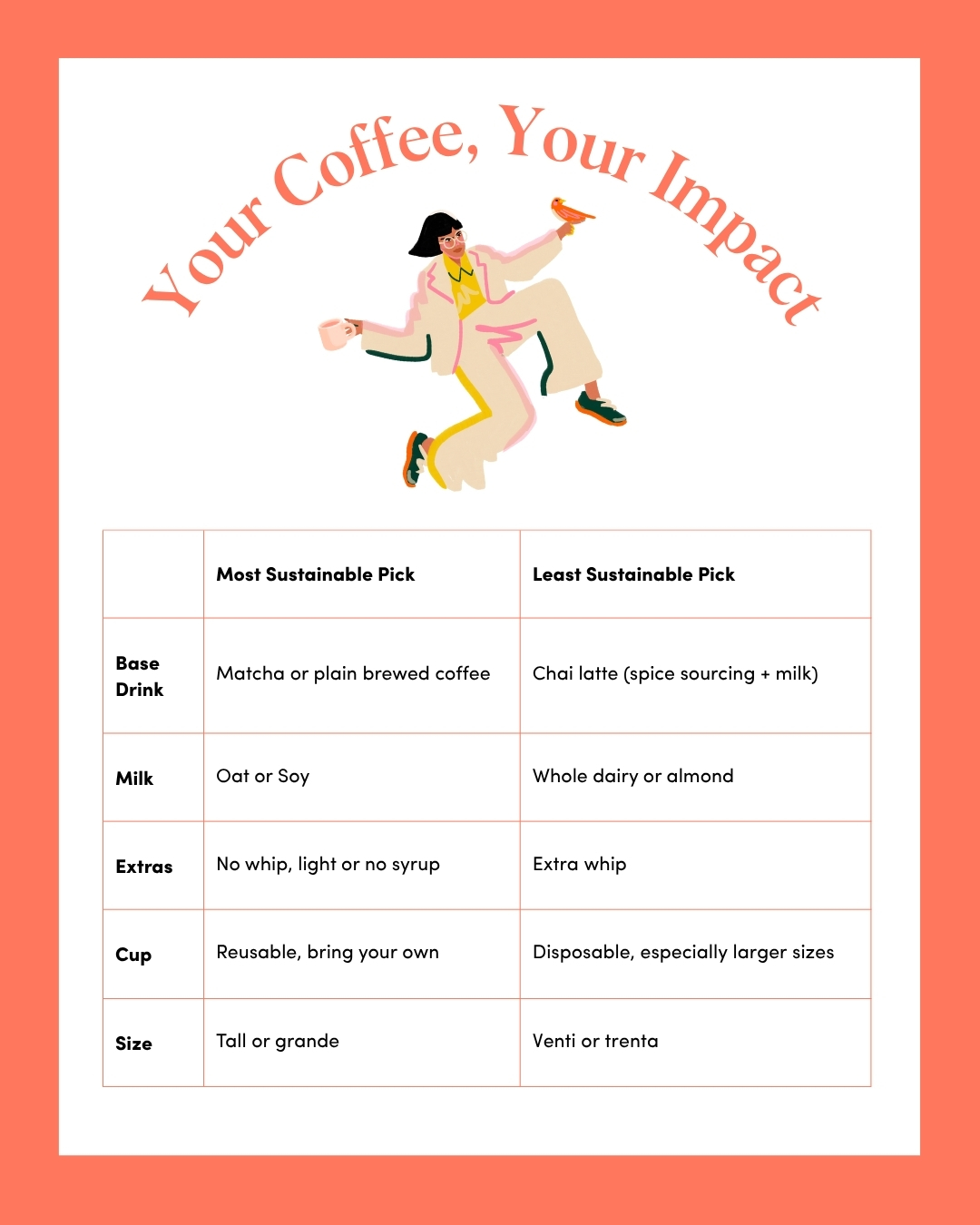
Stack the "most sustainable" column together and you get something like an iced matcha with oat milk, no whip, in your own cup. Stack the "least sustainable" column and you get a venti chai latte with whole milk and extra whip in a disposable cup.
Subscribe now to continue reading.
(16% discount)
• Access to unlimited articles
• Sustainable product guides & recommendations
• Weekly newsletters
Already a member? Log in.