


Who You Gonna Call? Your Library, Apparently.


Who You Gonna Call? Your Library, Apparently.
A Skeptic’s Guide To The Energy Ghosts Actually Haunting Your House
I’ve never seen a ghost in my house. But a half a block away, there are an estimated 2,000 of them.
Cheesman Park, the big green lawn in Denver where people go to jog, sunbathe, and play volleyball, started life in 1858 as Mount Prospect cemetery. By the 1880s, the cemetery had fallen into disrepair, and in 1890 Congress agreed to let the city turn it into a park. Families were told to move their loved ones, but thousands of graves went unclaimed. So in 1893, the city hired an undertaker named E.P. McGovern to relocate the remaining 5,000 or so bodies at $1.90 per coffin.
The Denver Republican reported a suspicious number of child-sized coffins leaving the site, and the allegations that followed (remains were being divided up to fill more coffins) are exactly as grim as they sound. McGovern was fired before the job was done. The headstones came out, the park went in, and a lot of people simple stayed where they were. Local historians estimate around 2,000 bodies are still under the grass, and irrigation work has actually turned up skeletons in the last 20 years.
So, do I believe in ghosts? There's an episode of This American Life called "The Question Trap" (episode 823, and I cannot recommend it enough) about innocent-sounding questions that are secretly asking something else. My favorite comes from Jessica, an ESL teacher in Atlanta, whose go-to question for a date is "Do you believe in ghosts?" She says there's no right answer. What matters is how it’s answered, because it tells her whether her date’s mind works the same way. She doesn't really believe in ghosts, but show her evidence and she'd change her mind. She’s open to the possibility of them. Her ex-fiancé's answer: no, and nothing anyone could show him would ever change that. His rigidity turned out to be one of the big things that broke them up.
When it comes to energy ghosts, I'm a Jessica. I'll believe it when I see the watt reading. So let's look at the evidence.
Ghost Story #1: The Phone Charger
You’ve heard this one around the campfire. Unplug your phone charger when you’re not using it, because it’s secretly sucking power out of the wall all day long. It might be the most repeated energy tip on the planet. Guess what? IT DOESN’T HOLD UP ANYMORE.
Since 2020, EU rules have capped chargers with nothing attached at 0.1 watts. Older US measurements put a typical idle charger around a quarter of a watt, which works out to roughly 30 cents of electricity if you let it plugged in for an entire year. You’d need somewhere around 100 idle chargers to match the draw of a single LED bulb.
If unplugging your charger sparks joy, carry on. Just know that old laptop bricks and cheap knockoff chargers can draw more, and that the real ghosts are elsewhere.
The Real Phantoms
In 2015, NRDC teamed up with Stanford researchers to analyze smart meter data from 70,000 northern California homes, plus detailed audits inside a handful of them. Devices designed around doing nothing (in standby, in sleep mode, or left on but unused) accounted for nearly 23% of household electricity. Nationally, NRDC estimated that idle load could be costing Americans up to $19 billion a year. This is a huge number but I’d also understand if you weren’t that impressed. After all, it’s only 2% of Elon Musk’s net worth.
Your spooky old furnace was barely a factor. Heating, cooling, lighting and refrigeration made up 15% of the idle load. The biggest culprit was consumer electronics: TVs, cable and streaming boxes, game consoles waiting in “instant on” mode, computers and printers. The rest was the weird stuff, like recirculation pumps, fish ponds and aquariums (get after it, CA!).
The Undead: Your Garage Fridge
Then there’s a different kind of ghost. It’s fully functional, humming along 24/7, and it has no reason to still be there.
Remember McGovern’s half-finished relocation job? Most of our homes have their own version. You buy a new fridge, and instead of retiring the old one, you move it to the garage for “party drinks.” We bought a second freezer for my breastmilk in our basement and now it’s home to local bison beef, TJ’s frozen pizzas, and a half-finished Brownie Pudding I made for Christmas. According to the AMerican Council for an Energy-Efficient Economy, second fridges are usually around 15 years old when they get demoted, and hang on for another 5 to 10 years.
One old garage fridge uses as much electricity as several hundred idle phone chargers, and EPA estimates that getting rid of a second fridge entirely saves up to 1,200 kWh a year.
If you really need one year-round, a new ENERGY STAR model uses a fraction of the power. And if you only need extra space for breastfeeding or around the holidays, plug it in for just those weeks or months. If you’re saying goodbye to it, recycle it properly since refrigerants have to be recovered by law.
Go Ghost Hunting With A Library Card
Every ghost hunter needs equipment, and ours is free. Denver Public LIbrary partners with Xcel to lend Power Check meters. You plug the meter into the wall, plug any appliance into the meter and it shows you exactly how many watts its drawing and what it costs. You can put that one on hold at any branch. Not in Denver? Lots of libraries lend Kill A Watt meters, often through local utility. So check your library’s “library of things.”
How to hunt:
1. Round up the usual suspects. Your TV setup, cable or streaming box, game console, printer, and anything with a clock or a glowing light.
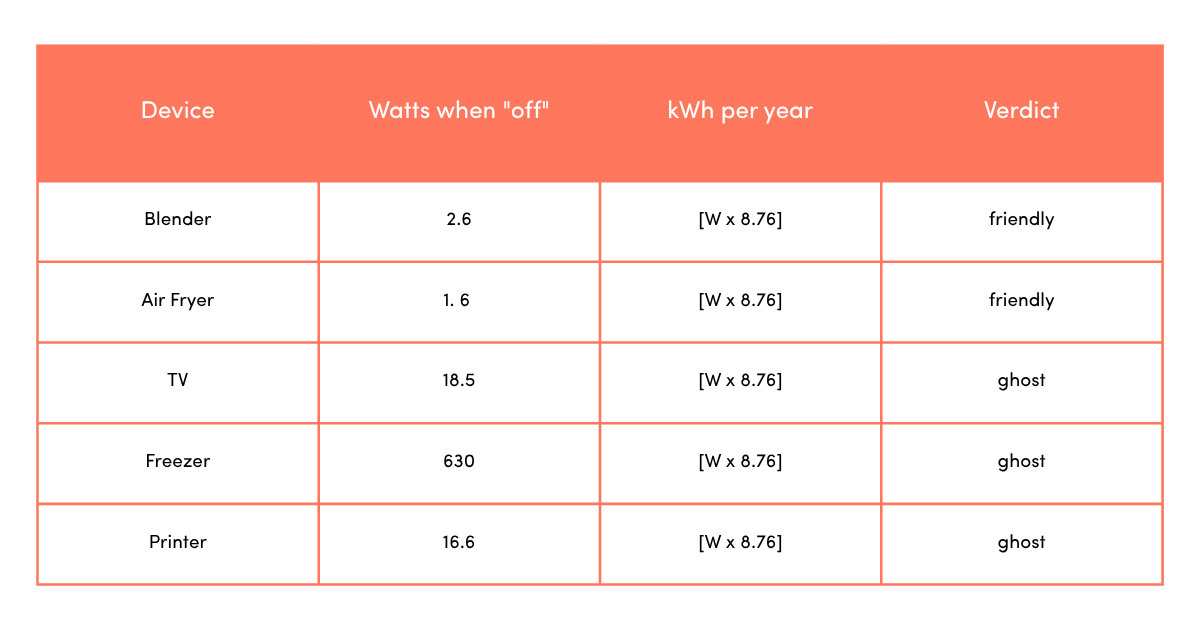
2. Measure them while they're "off." Multiply that standby wattage by 8.76 and you get kWh per year. A device pulling 10 watts in standby adds up to about 88 kWh a year.
3. Give the garage fridge a full day. Most meters can track total energy over time, which is a much better read on a fridge than a single snapshot.
4. Banish what you find. Turn off "instant on" or "quick start" modes on consoles and TVs, put entertainment centers on a smart power strip, and unplug the electronics in rooms you rarely use.
My ghost hunt results:
THE ABSOLUTION CORNER
Is my 12-foot inflatable skeleton a climate crime?
Relax. Large inflatables typically pull 120 to 145 watts to keep their fans running. Run a big one six hours a night for all of October and you land around 26 kWh. That garage fridge uses as much in a year as roughly 30 Octobers of your skeleton. Smaller inflatables can run on fans as low as about 7 watts.
Two notes before you declare victory. Put them on a timer so they're not billowing at 3am for an audience of raccoons. And the real villain of Halloween decor might be the fog machine, which can pull 400 to 700 watts to heat its fluid. Also worth remembering: the bigger footprint of a cheap inflatable is probably the polyester and plastic it's made from, so the most sustainable skeleton is the one you use for ten Halloweens in a row.
Subscribe now to continue reading.
(16% discount)
• Access to unlimited articles
• Sustainable product guides & recommendations
• Weekly newsletters
Already a member? Log in.


